

What Was Lashing As Black Punishment Youtube
Flagellation (Latin flagellum , 'whip'), flogging or whipping is the deed of beating the human trunk with special implements such as whips, rods, switches, the cat o' 9 tails, the sjambok, the knout, etc. Typically, flogging is imposed on an unwilling subject every bit a punishment; however, it tin can also be submitted to willingly for sadomasochistic pleasance, or performed on oneself, in religious or sadomasochistic contexts.
The strokes are normally aimed at the unclothed dorsum of a person, although they tin can be administered to other corporeal areas. For a chastened subform of flagellation, described as bastinado, the soles of a person'southward bare feet are used as a target for beating (see pes whipping).
In some circumstances the discussion flogging is used loosely to include whatsoever sort of corporal punishment, including birching and caning. However, in British legal terminology, a distinction was drawn (and still is, in ane or ii colonial territories[ citation needed ]) betwixt flogging (with a true cat o' 9 tails) and whipping (formerly with a whip, only since the early on 19th century with a birch). In Britain these were both abolished in 1948.
Current use as punishment [edit]
Officially abolished in most Western countries, flogging or whipping, including foot whipping in some countries, is still a mutual punishment in some parts of the globe,[ which? ] particularly in countries using Islamic law and in some territories which were former British colonies.[ commendation needed ] Medically supervised caning is routinely ordered past the courts as a penalisation for some categories of crime in Singapore, Brunei, Malaysia, Republic of indonesia, Tanzania, Zimbabwe and elsewhere.[ citation needed ]
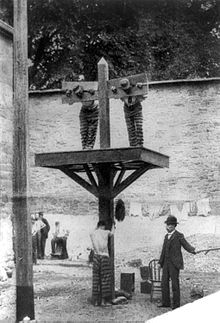
Prisoners at a whipping post in a Delaware prison, circa 1907
Historical use as penalization [edit]
Judaism [edit]
According to the Torah (Deuteronomy 25:1-three) and Rabbinic law lashes may exist given for offenses that do not merit capital letter punishment, and may non exceed 40. However, in the absenteeism of a Sanhedrin, corporal punishment is not proficient in Jewish police. Halakha specifies the lashes must exist given in sets of three, so the total number cannot exceed 39. Likewise, the person whipped is get-go judged whether they can withstand the penalty, if not, the number of whips is decreased. Jewish police express flagellation to 40 strokes, and in do delivered thirty-nine, so equally to avoid any possibility of breaking this law due to a miscount.
Antiquity [edit]
It is a myth that in Sparta, young men were flogged every bit a test of their masculinity.
In the Roman Empire, flagellation was oftentimes used every bit a prelude to crucifixion, and in this context is sometimes referred to equally scourging. About famously according to the gospel accounts, this occurred prior to the crucifixion of Jesus Christ.
Whips with minor pieces of metal or os at the tips were commonly used. Such a device could easily crusade disfigurement and serious trauma, such as ripping pieces of flesh from the body or loss of an centre. In addition to causing severe pain, the victim would approach a state of hypovolemic stupor due to loss of blood.
The Romans reserved this treatment for non-citizens, as stated in the lex Porcia and lex Sempronia , dating from 195 and 123 BC. The poet Horace refers to the horribile flagellum (horrible whip) in his Satires. Typically, the one to be punished was stripped naked and spring to a depression colonnade so that he could bend over it, or chained to an upright pillar and then equally to exist stretched out. Two lictors (some reports indicate scourgings with four or half-dozen lictors) alternated blows from the bare shoulders downwardly the torso to the soles of the feet. There was no limit to the number of blows inflicted—this was left to the lictors to decide, though they were normally non supposed to kill the victim. Nonetheless, Livy, Suetonius and Josephus study cases of flagellation where victims died while still bound to the mail. Flagellation was referred to every bit "half death" by some authors, every bit many victims died shortly thereafter. Cicero reports in In Verrem , " pro mortuo sublatus brevi postea mortuus " ("taken away for a expressionless man, shortly thereafter he was dead").
From Middle Ages to modern times [edit]
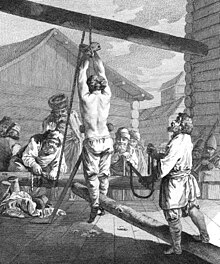
Penalization with a knout (Russia, 18th century)
The Whipping Act was passed in England in 1530. Under this legislation, vagrants were to be taken to a nearby populated area "and there tied to the end of a cart naked and beaten with whips throughout such market place town till the body shall exist bloody".[i]
In England, offenders (mostly those convicted of theft) were normally sentenced to be flogged "at a cart's tail" forth a length of public street, normally near the scene of the crime, "until his [or her] back exist bloody". In the late seventeenth century, however, the courts occasionally ordered that the flogging should be carried out in prison or a house of correction rather than on the streets. From the 1720s courts began explicitly to differentiate between individual whipping and public whipping. Over the course of the eighteenth and early nineteenth centuries the proportion of whippings carried out in public declined, only the number of private whippings increased. The public whipping of women was abolished in 1817 (afterwards having been in decline since the 1770s) and that of men ended in the early 1830s, though not formally abolished until 1862. Individual whipping of men in prison continued and was not abolished until 1948.[2] The 1948 abolition did not affect the ability of a prison house's visiting justices (in England and Wales, but not in Scotland, except at Peterhead) to order the birch or true cat for prisoners committing serious assaults on prison staff. This ability was not abolished until 1967, having been last used in 1962.[3]
Whipping occurred during the French Revolution, though not as official punishment. On 31 May 1793, the Jacobin women seized a revolutionary leader, Anne Josephe Theroigne de Mericourt, stripped her naked, and flogged her on the blank bottom in the public garden of the Tuileries. After this humiliation, she refused to wear any dress, in retentiveness of the outrage she had suffered.[four] She went mad and concluded her days in an asylum after the public whipping.
In the Russian Empire, knouts were used to flog criminals and political offenders. Sentences of a hundred lashes would normally result in decease. Whipping was used as a penalization for Russian serfs.[5]
In April 2020, Kingdom of saudi arabia said it would supervene upon flogging with prison sentences or fines, according to a government document.[6]
Utilize against slaves [edit]

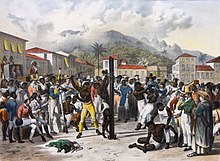
Whipping has been used as a form of subject area on slaves. Information technology was frequently carried out during the menstruation of slavery in the United States, by slave owners and their slaves. The ability was likewise given to slave "patrolers," generally poor whites authorized to whip any slave who violated the slave codes.
Flogging as military penalty [edit]
In the 18th and 19th centuries, European armies administered floggings to mutual soldiers who committed breaches of the military code.
United States [edit]
During the American Revolutionary War, the American Congress raised the legal limit on lashes from 39 to 100 for soldiers who were convicted by courts-martial.[7] More often than not, officers were not flogged. However, in 1745, a cashiered British officeholder'south sword could be broken over his head, amid other indignities inflicted on him.[8]
Every bit critics of flogging aboard the ships and vessels of the Us Navy became more vocal, the Department of the Navy began in 1846 to require annual reports of subject field including flogging, and limited the maximum number of lashes to 12. These annual reports were required from the captain of each naval vessel. See thumbnail for the 1847 disciplinary study of the USS John Adams (1799). The individual reports were and then compiled so the Secretary of the Navy could report to the U.s.a. Congress how pervasive flogging had go and to what extent it was utilized.[nine] In full for the years 1846–1847, flogging had been administered a reported 5,036 times on sixty naval vessels.[ten] At the urging of New Hampshire Senator John P. Hale, the United States Congress banned flogging on all U.S. ships in September 1850, as function of a then-controversial amendment to a naval appropriations nib.[xi] [12] Unhurt was inspired by Herman Melville's "vivid description of flogging, a roughshod staple of 19th century naval bailiwick" in Melville's "novelized memoir" White Jacket.[13] [eleven] Melville besides included a vivid depiction of flogging, and the circumstances surrounding it, in his more famous piece of work, Moby-Dick.

1847 disciplinary report re flogging, on the USS John Adams. The Us Congress banned flogging on all U.S. ships on 28 September 1850
Armed services flogging was abolished in the United States Army on 5 August 1861.[14]
United kingdom of great britain and northern ireland [edit]
Flagellation was so common in England equally punishment that caning (and spanking and whipping) are chosen "the English language vice".[fifteen]
Flogging was a common disciplinary measure out in the Royal Navy that became associated with a seaman's manly disregard for pain.[16] Aboard ships, knittles or the cat o' 9 tails was used for severe formal punishment, while a "rope's end" or "starter" was used to administer informal, on-the-spot discipline. In astringent cases a person could be "flogged around the fleet": a significant number of lashes (up to 600) was divided amidst the ships on a station and the person was taken to all ships to be flogged on each.[17]
In June 1879 a motion to abolish flogging in the Royal Navy was debated in the House of Commons. John O'Connor Power, the member for Mayo, asked the First Lord of the Admiralty to bring the navy cat o' nine tails to the Commons Library then that the members might see what they were voting well-nigh. Information technology was the Peachy "Cat" Contention, "Mr Speaker, since the Government has let the cat out of the bag, there is nothing to be done but to accept the balderdash by the horns." Poet Laureate Ted Hughes celebrates the occasion in his poem, "Wilfred Owen'due south Photographs": "A witty profound Irishman calls/For a 'cat' into the House, and sits to watch/The gentry fingering its stained tails./Whereupon ...Quietly, unopposed,/The motion was passed."[xviii]

In the Napoleonic Wars, the maximum number of lashes that could be inflicted on soldiers in the British Army reached i,200. This many lashes could permanently disable or kill a human. Charles Oman, historian of the Peninsular War, noted that the maximum sentence was inflicted "nine or ten times past general court-martial during the whole 6 years of the war" and that i,000 lashes were administered about 50 times.[19] Other sentences were for 900, 700, 500 and 300 lashes. One soldier was sentenced to 700 lashes for stealing a beehive.[20] Another human being was permit off after only 175 of 400 lashes, but spent iii weeks in the hospital.[21] Afterward in the war, the more than callous punishments were abandoned and the offenders shipped to New Southward Wales instead, where more whippings oftentimes awaited them. (See Australian penal colonies section.) Oman afterward wrote:
If annihilation was calculated to brutalize an ground forces it was the wicked cruelty of the British armed forces penalisation code, which Wellington to the end of his life supported. In that location is plenty of dominance for the fact that the human who had in one case received his 500 lashes for a fault which was small, or which involved no moral guilt, was ofttimes turned thereby from a skilful soldier into a bad soldier, by losing his self-respect and having his sense of justice seared out. Adept officers knew this well enough, and did their best to avoid the cat o' nine tails, and to try more than rational means—more often than not with success.[22]
The 3rd battalion's Royal Anglian Regiment nickname of "The Steelbacks" is taken from 1 of its one-time regiments, the 48th (Northamptonshire) Regiment of Foot who earned the nickname for their stoicism when being flogged with the cat o' nine tails ("Not a whimper under the lash"), a routine method of administering penalty in the Ground forces in the 18th and early 19th centuries.
France [edit]
Meanwhile, during the French Revolutionary Wars the French Army stopped floggings altogether. The King's German Legion (KGL), which were German units in British pay, did not flog. In one case, a British soldier on detached duty with the KGL was sentenced to be flogged, but the German commander refused to carry out the punishment. When the British 73rd Human foot flogged a man in occupied French republic in 1814, disgusted French citizens protested against it.[23]
Australian penal colonies [edit]

Once mutual in the British Army and British Royal Navy as a means of bailiwick, flagellation also featured prominently in the British penal colonies in early on colonial Australia. Given that convicts in Commonwealth of australia were already "imprisoned", punishments for offenses committed there could not normally result in imprisonment and thus ordinarily consisted of corporal punishment such as hard labour or flagellation. Unlike Roman times, British constabulary explicitly forbade the combination of corporal and capital punishment; thus, a convict was either flogged or hanged but never both.
Flagellation took identify either with a unmarried whip or, more than notoriously, with the cat o' 9 tails. Typically, the offender's upper half was bared and he was suspended by the wrists beneath a tripod of wooden beams (known as 'the triangle'). In many cases, the offender's feet barely touched ground, which helped to stretch the skin taut and increase the damage inflicted past the whip. It also centered the offender's weight in his shoulders, further ensuring a painful experience.
With the prisoner thus stripped and bound, either one or two floggers administered the prescribed number of strokes, or "lashes," to the victim's back. During the flogging, a doctor or other medical worker was consulted at regular intervals as to the status of the prisoner. In many cases, however, the physician merely observed the offender to decide whether he was conscious. If the prisoner passed out, the md would order a halt until the prisoner was revived, and and then the whipping would continue.
Female convicts were also subject to flogging as punishment, both on the captive ships and in the penal colonies. Although they were generally given fewer lashes than males (unremarkably limited to 40 in each flogging), there was no other difference between the manner in which males and females were flogged.
Floggings of both male and female convicts were public, administered before the whole colony'southward company, assembled specially for the purpose. In addition to the infliction of pain, one of the principal purposes of the flogging was to humiliate the offender in front of his mates and to demonstrate, in a forceful way, that he had been required to submit to dominance.
At the conclusion of the whipping, the prisoner'southward lacerated back was normally rinsed with brine, which served equally a crude and painful disinfectant.
Flogging nonetheless continued for years after independence. The last person flogged in Australia was William John O'Meally in 1958 in Melbourne'due south Pentridge Prison.
Contemporary Syria [edit]
In Syria where torture of political dissidents, POWs and civilians is extremely common,[24] [25] flagellation has go 1 of the well-nigh mutual forms of torture.[26] Flagellation is used by both the Gratuitous Syrian Regular army,[27] and by the Syrian Arab Regular army,[28] however is not practiced by the Syrian Democratic Forces.[29] ISIS most commonly used flagellation in which people would be tied to a ceiling and whipped,[30] it was extremely common in Raqqa Stadium, a makeshift prison where prisoners were tortured.[31] [32] It was also common for those who did non follow ISIS strict laws to be publicly flogged.
Every bit a religious practice [edit]
Antiquity [edit]
During the Aboriginal Roman festival of Lupercalia, immature men ran through the streets with thongs cut from the hide of goats which had merely been sacrificed, whipping people with the thongs as they ran. Co-ordinate to Plutarch, women would put themselves in their style to receive blows on the hands, believing that this would help them to conceive or grant them an piece of cake delivery.[33] The eunuch priests of the goddess Cybele, the galli, flogged themselves until they bled during the almanac festival called Dies Sanguinis.[34] The initiation ceremonies of Greco-Roman mystery religions likewise sometimes involved ritual flagellation, every bit did the Spartan cult of Artemis Orthia.[35]
Christianity [edit]

The Flagellation, in a Christian context, refers to an episode in the Passion of Christ prior to Jesus' crucifixion. The do of mortification of the mankind for religious purposes has been utilised past members of various Christian denominations since the time of the Neat Schism in 1054. Nowadays the musical instrument of penance is chosen a discipline, a cattail whip usually fabricated of knotted cords, which is flung over the shoulders repeatedly during private prayer.[36]
In the 13th century, a group of Roman Catholics, known equally the Flagellants, took self-mortification to extremes. These people would travel to towns and publicly shell and whip each other while preaching repentance. The nature of these demonstrations existence quite morbid and disorderly, they were during periods of time suppressed by the authorities. They continued to reemerge at dissimilar times up until the 16th century.[37] [38] Flagellation was also practised during the Blackness Plague equally a ways to purify oneself of sin and thus prevent contracting the disease. Pope Clement Vi is known to have permitted it for this purpose in 1348.[39]
Martin Luther, the Protestant Reformer, regularly good cocky-flagellation as a ways of mortification of the flesh before leaving the Roman Catholic Church.[xl] Likewise, the Congregationalist author Sarah Osborn (1714-1796) likewise practiced self-flagellation in order "to remind her of her continued sin, depravity, and vileness in the eyes of God".[41] Information technology became "quite common" for members of the Tractarian movement (see Oxford Movement, 1830s onwards) within the Anglican Communion to practice self-flagellation using the discipline.[42] St. Thérèse of Lisieux, a late 19th-century French Discalced Carmelite nun considered in Catholicism to exist a Doctor of the Church, is an influential instance of a saint who questioned prevailing attitudes toward physical penance. Her view was that loving acceptance of the many sufferings of daily life was pleasing to God, and fostered loving relationships with other people, more than taking upon oneself extraneous sufferings through instruments of penance. Equally a Carmelite nun, Saint Thérèse skillful voluntary corporal mortification.
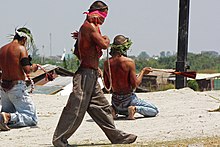
Some members of strict monastic orders, and some members of the Catholic lay organization Opus Dei, practice mild self-flagellation using the field of study.[36] Pope John Paul II took the discipline regularly.[43] Self-flagellation remains common in Colombia, the Philippines, United mexican states, Spain and ane convent in Peru.[ citation needed ]
Shi'a Islam [edit]
As suffering and cutting the body with knives or chains (matam) accept been prohibited past Shi'a marjas like Ali Khamenei, Supreme Leader of Iran,[44] some Shi'a detect mourning with blood donation which is chosen "Qame Zani"[44] and flailing.[45] Nevertheless some Shi'ite men and boys continue to slash themselves with chains (zanjeer) or swords (talwar) and allow their blood to run freely.[45]
Sure rituals similar the traditional flagellation ritual called Talwar zani (talwar ka matam or sometimes tatbir) using a sword or zanjeer zani or zanjeer matam, involving the apply of a zanjeer (a chain with blades) are also performed.[46] These are religious customs that show solidarity with Husayn and his family unit. People mourn the fact that they were non nowadays at the battle to fight and salve Husayn and his family unit.[ dubious ] [47] [ better source needed ] [48] [ amend source needed ] In some western cities, Shi'a communities have organized blood donation drives with organizations like the Red Cross on Ashura every bit a positive replacement for self-flagellation rituals like Tatbir and Qame Zani.
As a sexual do [edit]

Flagellation is also used equally a sexual activity in the context of BDSM. The intensity of the chirapsia is ordinarily far less than used for penalty.
There are anecdotal reports of people willingly beingness spring or whipped, as a prelude to or substitute for sex, during the 14th century.[49] Flagellation practiced inside an erotic setting has been recorded from at to the lowest degree the 1590s evidenced past a John Davies epigram,[50] [51] and references to "flogging schools" in Thomas Shadwell'southward The Virtuoso (1676) and Tim Tell-Troth'southward Knavery of Star divination (1680).[52] [53] Visual evidence such as mezzotints and print media in the 1600s is also identified revealing scenes of flagellation, such as in the late seventeenth-century English language mezzotint "The Cully Flaug'd" from the British Museum drove.[52]
John Cleland'south novel Fanny Colina, published in 1749, incorporates a flagellation scene betwixt the character'southward protagonist Fanny Loma and Mr Barville.[54] A large number of flagellation publications followed, including Fashionable Lectures: Composed and Delivered with Birch Subject field (c1761), promoting the names of ladies offering the service in a lecture room with rods and cat o' 9 tails.[55]
See too [edit]
- Algolagnia
- Flagellant confraternities
- Flaying
- Florentine flogging
- List of films and TV containing corporal penalty scenes
- Mortification of the mankind
- Paddle (spanking)
- Spanking
References [edit]
- ^ One or more of the preceding sentences incorporates text from a publication at present in the public domain:Chisholm, Hugh, ed. (1911). "Whipping". Encyclopædia Britannica. Vol. 28 (11th ed.). Cambridge University Press. pp. 590–591.
- ^ London lives
- ^ "JUDICIAL AND Prison FLOGGING AND WHIPPING IN BRITAIN". www.corpun.com.
- ^ Roudinesco, Elisabeth (1992). Madness and Revolution: The Lives and Legends of Theroigne de Mericourt, Verso. ISBN 0-86091-597-2. p.198
- ^ Chapman, Tim (2001). Imperial Russia, 1801-1905. Routledge. p.83. ISBN 0-415-23110-eight
- ^ "Kingdom of saudi arabia to end flogging every bit form of punishment: document". Reuters. 24 April 2020.
- ^ Martin, p 76.
- ^ Tomasson, p 127.
- ^ "Sharp, John G.M., Flogging at Sea, Discipline and Penalty in the Old Navy 25 November 2020". www.usgwarchives.internet.
- ^ Parker, Hershel, Herman Melville A Biography Book 1, 1819-1851(Baltimore, The Johns Hopkins Academy Press 1996)p.262
- ^ a b Hodak, George. "Congress Bans Maritime Flogging". ABA Journal. September 1850, p. 72. Retrieved 18 October 2010.
- ^ 31st Congress, Session one, Chapter fourscore (1850), p515. Archived xi Oct 2015 at the Wayback Motorcar Quote: "Provided, That flogging in the navy, and on board vessels of commerce, be, and the same is hereby, abolished from and later on the passage of this act."
- ^ "Precipitous, John K.Chiliad. The Ship Log of the frigate USS United States 1843 - 1844 and Herman Melville Ordinary Seaman 2019, pp iii-four accessed 12 December 2020". www.usgwarchives.net.
- ^ Weigley, Russell (1984). History of the U.s. Ground forces. ISBN978-0253203236.
- ^ Thomas Edward Murray; Thomas R. Murrell (1989). The Language of Sadomasochism: A Glossary and Linguistic Analysis. ABC-CLIO. pp. 23–. ISBN978-0-313-26481-8.
- ^ "Life at ocean in the age of canvass". National Maritime Museum.
- ^ Keith Grint, The Arts of Leadership, 2000, ISBN 0191589330 pp.237-238
- ^ Hughes, Ted, "Wilfred Owen's Photographs", Lupercal, 1960. See as well Stanford, Jane, That Irishman: the Life and Times of John O'Connor Power, 2011, pp. 79-80.
- ^ Oman, p 239.
- ^ Oman, p 246.
- ^ Oman, p 254.
- ^ Oman, p.43.
- ^ Rothenberg, p.179.
- ^ "If the Dead Could Speak". sixteen December 2015.
- ^ "Vicious torture in Syrian prison network detailed past New York Times investigation | CBC Radio".
- ^ http://sn4hr.org/wp-content/pdf/english/Documentation_of_72_Torture_Methods_the_Syrian_Regime_Continues_to_Practice_in_Its_Detention_Centers_and_Military_Hospitals_en.pdf[ blank URL PDF ]
- ^ "Syria: Stop Opposition Apply of Torture, Executions". 17 September 2012.
- ^ "Rare Video Evidence of Torture in Syrian Hospitals". PBS.
- ^ "Syrian arab republic: Abuses in Kurdish-run Enclaves". 18 June 2014.
- ^ "Republic of iraq: Chilling Accounts of Torture, Deaths". 19 August 2018.
- ^ "Smuggled video testimony documents harsh rule of Syrian Islamist group". TheGuardian.com. 19 February 2014.
- ^ Wilgenburg, Wladimir van (24 October 2017). "Secrets of the Blackness Stadium: In Raqqa, Within ISIS' House of Horror". The Daily Beast.
- ^ "Plutarch: The Life of Julius Caesar (section 61)". LacusCurtius. Retrieved 3 February 2022.
- ^ Meyer, Marvin W. (1999). The Ancient Mysteries: A Sourcebook of Sacred Texts. University of Pennsylvania Press. p. 114. ISBN978-0-8122-1692-9.
- ^ Braunlein, Peter J. (2010). "Flagellation". In Melton, J. G.; Baumann, One thousand. (eds.). Religions of the Earth. ABC-CLIO. p. 1119. ISBN978-1-59884-204-3.
- ^ a b "Opus Dei and corporal mortification". Opus Dei Information Function. 2012.
- ^ "Flagellants". Encyclopædia Britannica. Encyclopædia Britannica, inc. six December 2016. Retrieved 9 October 2018.
- ^ "Flagellants". The Columbia Encyclopedia (6th ed.). 7 October 2018. Retrieved 9 October 2018.
- ^ Leslie Alexander St. Lawrence Toke (1913). . In Herbermann, Charles (ed.). Catholic Encyclopedia. New York: Robert Appleton Company.
- ^ Wall, James T. The Boundless Frontier: America from Christopher Columbus to Abraham Lincoln. University Press of America. p. 103.
Though he did not get to the ends that had Luther— including fifty-fifty self-flagellation— the methods of ritualistic observance, self-denial, and skillful works did not satisfy.
- ^ Rubin, Julius H. (1994). Religious Melancholy and Protestant Experience in America. Oxford Academy Press. p. 115. ISBN9780195083019.
In the many letters to her correspondents, Fish, Anthony, Hopkins, and Noyes, Osborn examined the state of her soul, sought spiritual guidance in the midst of her perplexities, and created a written forum for her continued self-examination. She cultivated an intense and abiding spirit of evangelical humiliation--cocky-flagellation and self-torture to remind her of her continued sin, depravity, and vileness in the optics of God.
- ^ Yates, Nigel (1999). Anglican Ritualism in Victorian Uk, 1830-1910. Oxford Academy Press. p. sixty. ISBN9780198269892.
Cocky-flagellation with a small scourge, known equally a discipline, became quite common in Tractarian circles and was practised by Gladstone amidst others.
- ^ Barron, Fr. Robert. "Taking the Discipline". YouTube. Archived from the original on 7 Nov 2021.
- ^ a b Akramulla Syed (20 February 2009). "Zanjeer Or Qama Zani on Ashura During Muharram". Ezsoftech.com. Retrieved 30 June 2012.
- ^ a b "Ashura observed with blood streams to mark Karbala tragedy". Jafariya News Network. Retrieved 28 December 2010.
- ^ "Scars on the backs of the immature". New Statesman. London. 6 June 2005. Retrieved 28 December 2010.
- ^ Bird, Steve (28 August 2008). "Devout Muslim guilty of making boys vanquish themselves during Shia ceremony". The Times. London. Retrieved 1 May 2010. (subscription required)
- ^ "British Muslim bedevilled over teen floggings". Alarabiya.internet. 27 August 2008. Retrieved 28 December 2010.
- ^ Arne Hoffmann: In Leder gebunden. Der Sadomasochismus in der Weltliteratur, Folio 11, Ubooks 2007, ISBN 978-three-86608-078-ii (German)
- ^ Epigram 33: "In Francum"
- ^ Bromley, James G. (ane May 2010). "Social Relations and Masochistic Sexual Practise in The Overnice Valour". Modern Philology. 107 (four): 556–587. doi:x.1086/652428. ISSN 0026-8232. S2CID 144194164.
- ^ a b Jones, M (2007) "Impress of the Month: The Cully Flaug'd" in British Printed Images (BPI) to 1700
- ^ Nomis, Anne O (2013) "Flogging Schools and Their Cullies" in "The History & Arts of the Dominatrix" Mary Egan Publishing and Anna Nomis Ltd, 2013. ISBN 978-0-9927010-0-0 pp.fourscore-81
- ^ John Cleland: Fanny Loma: Memoirs of a Woman of Pleasure, Penguin Classics, (seven January 1986), ISBN 978-0-14-043249-7 Page 180 ff
- ^ Stylish Lectures Equanimous and Delivered with Birch Field of study (c1761) British Library Rare Books collection

Further reading [edit]
- Bean, Joseph West. Flogging, Greenery Press, 2000. ISBN i-890159-27-1
- Bertram, James Drinking glass. (1877 edition). Flagellation and the Flagellants: A History of the Rod. London: William Reeves.
- Conway, Andrew. The Bullwhip Book. Greenery Press, 2000. ISBN 1-890159-18-ii
- Gibson, Ian. The English Vice: Beating, Sex and Shame in Victorian England and Later on. London: Duckworth, 1978. ISBN 0-7156-1264-6
- Martin, James Kirby; Lender, Mark Edward. A Respectable Army: The Military machine Origins of the Commonwealth, 1763-1789. Arlington Heights, Ill.: Harlan Davidson, 1982. ISBN 0-88295-812-7
- Oman, Charles. Wellington'due south Army, 1809-1814. London: Greenhill, (1913) 1993. ISBN 0-947898-41-7
- Rothenberg, Gunther East. (1980). The Fine art of Warfare in the Age of Napoleon. Bloomington, Indiana: Indiana University Press. ISBN0-253-31076-8.
- Ricker, Kat. Doubting Thomas, Trillium Press, 2010. ISBN 978-0-615-31849-3 Suspense thriller examining the night nature of saintliness, including flagellation.
- Tomasson, Katherine & Buist, Francis. Battles of the '45. London: Pan Books, 1974.
External links [edit]
-
 Media related to Flagellation at Wikimedia Eatables
 - Folio virtually corporal punishment in the world
- "Forensic and Clinical Noesis of the Practice of Crucifixion" by Dr. Frederick Zugibe
- Pilot Guides - Flogging in penal Australia (including animation)
- Information near a public penalization in Iran considering alcohol and sex outside marriage
- Cosmic Encyclopedia: Flagellation
- Suffering and Sainthood The importance of penance and mortification in the Catholic Church
Source: https://en.wikipedia.org/wiki/Flagellation
Posted by: howardtheirch.blogspot.com
0 Response to "What Was Lashing As Black Punishment Youtube"
Post a Comment