

Form One Mathematics Notes Pdf

TOPIC 1: NUMBERS
we know that when we count we start 1,2 .... . But there are other numbers like 0, negative numbers and decimals. All these types of numbers are categorized in different groups like counting numbers, integers,real numbers, whole numbers and rational and irrational numbers according to their properties. all this have been covered in this chapter
Numbers are represented by symbols called numerals. For example, numeral for the number ten is 10. Numeral for the number hundred is 110 and so on.
The symbols which represent numbers are called digits. For example the number 521 has three (3) digits which are 5, 2 and 1. There are only tendigits which are used to represent any number. These digits are 0, 1, 2, 3, 4, 5, 6, 7, 8, and 9.
The Place Value in each Digit in Base Ten Numeration
Identify the place value in each digit in base ten numeration
When we write a number, for example 521, each digit has a different value called place value. The 1 on the right means 1 ones which can be written as 1 × 1, the next number which is 2 means 2 tens which can be written as 2 × 10 and the last number which is 5 means 5 hundreds which can be written as 5 × 100. Therefore the number 521 was found by adding the numbers 5 × 100 + 2 × 10 + 1× 1 = 521.
Note that when writing numbers in words, if there is zero between numbers we use word 'and'
Example 1
Write the following numbers in words:
- 7 008
- 99 827 213
- 59 000
Solution
- 7 008 = Seven thousand and eight.
- 99 827 213 = Ninety nine millions eight hundred twenty seven thousand two hundred thirteen.
- 59 000 = Fifty nine thousand.
Example 2
Write the numbers bellow in expanded form.
- 732.
- 1 205.
Solution
- 732 = 7 x 100 + 3 x 10 + 2 x 1
- 1 205 = 1 x 1000 + 2 x 100 + 0 x 10 + 5 x 1
Example 3
Write in numerals for each of the following:
- 9 x 100 + 8 x 10 + 0 x 1
- Nine hundred fifty five thousand and five.
Solution
- 9 x 100 + 8 x 10 + 0 x 1 = 980
- Nine hundred fifty five thousand and five = 955 005.
Example 4
For each of the following numbers write the place value of the digit in brackets.
- 89 705 361 (8)
- 57 341 (7)
Solution
- 8 is in the place value of ten millions.
- 7 is in the place value of thousands.
Numbers in Base Ten Numeration
Read numbers in base ten numeration
Base Ten Numeration is a system of writing numbers using ten symbols i.e. 0, 1, 2, 3, 4, 5, 6, 7, 8 and 9. Base Ten Numeration is also called decimal system of Numeration.
Numbers in Base Ten Numeration up to One Billion
Write numbers in base ten numeration up to one billion
Consider the table below showing place values of numbers up to one Billion.
| Billions | Hundred millions | Ten millions | Millions | Hundred Thousands | Ten Thousands | Thousands | Hundreds | Tens | Ones |
| | | | | | | | | | 1 |
| | | | | | | | | 1 | 0 |
| | | | | | | | 1 | 0 | 0 |
| | | | | | | 1 | 0 | 0 | 0 |
| | | | | | 1 | 0 | 0 | 0 | 0 |
| | | | | 1 | 0 | 0 | 0 | 0 | 0 |
| | | | 1 | 0 | 0 | 0 | 0 | 0 | 0 |
| | | 1 | 0 | 0 | 0 | 0 | 0 | 0 | 0 |
| | 1 | 0 | 0 | 0 | 0 | 0 | 0 | 0 | 0 |
| 1 | 0 | 0 | 0 | 0 | 0 | 0 | 0 | 0 | 0 |
If you are given numerals for a number having more than three digits, you have to write it by grouping the digits into groups of three digits from right. For example 7892939 is written as 7 892 939.
When we are writing numbers in words we consider their place values. For example; if we are told to write 725 in words, we first need to know the place value of each digit. Starting from right side 5 is in the place value of ones, 2 is in the place value of tens and seven is in the place value of hundreds. Therefore our numeral will be read as seven hundred twenty five.
Numbers in Daily Life
Apply numbers in daily life
Numbers play an important role in our lives. Almost all the things we do involve numbers and Mathematics. Whether we like it or not, our life revolves in numbers since the day we were born. There are numerous numbers directly or indirectly connected to our lives.
The following are some uses of numbers in our daily life:
- Calling a member of a family or a friend using mobile phone.
- Calculating your daily budget for your food, transportation, and other expenses.
- Cooking, or anything that involves the idea of proportion and percentage.
- Weighing fruits, vegetables, meat, chicken, and others in market.
- Using elevators to go places or floors in the building.
- Looking at the price of discounted items in a shopping mall.
- Looking for the number of people who liked your post on Facebook.
- Switching the channels of your favorite TV shows.
- Telling time you spent on work or school.
- Computing the interest you gained on your business.
Integers
Identify integers
Consider a number line below

The numbers from 0 to the right are called positive numbers and the numbers from 0 to the left with minus (-) sign are called negative numbers. Therefore all numbers with positive (+) or negative (-) sign are called integers and they are denoted by Ζ. Numbers with positive sign are written without showing the positive sign. For example +1, +2, +3, … they are written simply as 1, 2, 3, … . But negative numbers must carry negative sign (-). Therefore integers are all positive and negative numbers including zero (0). Zero is neither positive nor negative number. It is neutral.
The numbers from zero to the right increases their values as the increase. While the numbers from zero to the left decrease their values as they increase. Consider a number line below.

If you take the numbers 2 and 3, 3 is to the right of 2, so 3 is greater than 2. We use the symbol '>' to show that the number is greater than i. e. 3 >2(three is greater than two). And since 2 is to the left of 3, we say that 2 is smaller than 3 i.e. 2<3. The symbol '<' is use to show that the number is less than.
Consider numbers to the left of 0. For example if you take -5 and -3. -5 is to the left of -3, therefore -5 is smaller than -3. -3 is to the right of -5, therefore -3 is greater than -5.
Generally, the number which is to the right of the other number is greater than the number which is to the left of it.
If two numbers are not equal to each to each other, we use the symbol '≠' to show that the two numbers are not equal. The not equal to '≠' is the opposite of is equal to '='.
Example 21
Represent the following integers Ζ on a number line
- 0 is greater than Ζ and Ζ is greater than -4
- -2 is less than Ζ and Ζ is less than or equal to 1.
a. 0 is greater than Ζ means the integers to the left of zero and Ζ is greater than -4 means integers to the left of -4. These numbers are -1, -2 and -3. Consider number line below

b. -2 is less than Ζ means integers to the right of -2 and Ζ is less than or equal to 1 means integers to the left of 1 including 1. These integers are -1, 0 and 1. Consider the number line below

Example 22
Put the signs 'is greater than' (>), 'is less than' (<), 'is equal to' (=) to make a true statement.
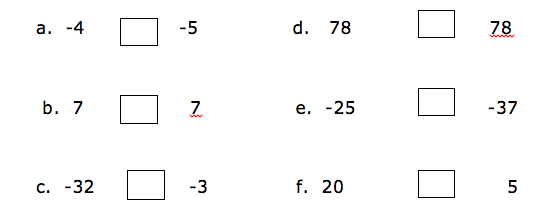
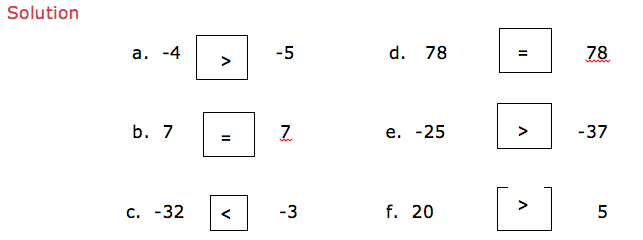
Addition of Integers
Add integers
Example 23
Show a picture of 2 and 3 on a number line.
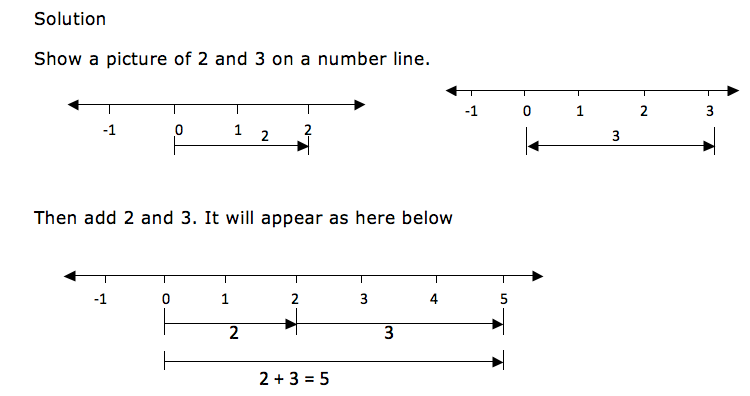
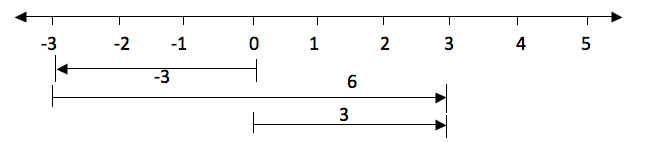
When drawing integers on a number line, the arrows for the positive numbers goes to the right while the arrows for the negative numbers goes to the left. Consider an illustration bellow.
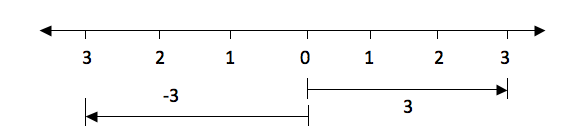
The distance from 0 to 3 is the same as the distance from 0 to -3, only the directions of their arrows differ. The arrow for positive 3 goes to the right while the arrow for the negative 3 goes to the left.
Example 24
Solution
Subtraction of Integers
Subtract integers
Since subtraction is the opposite of addition, if for example you are given 5-4 is the same as 5 + (-4). So if we have to subtract 4 from 5 we can use a number line in the same way as we did in addition. Therefore 5-4 on a number line will be:
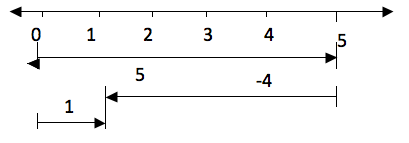
Take five steps from 0 to the right and then four steps to the left from 5. The result is 1.
Multiplication of Integers
Multiply integers
Example 25
2×6 is the same as add 2 six times i.e. 2×6 = 2 + 2 + 2 + 2 + 2 +2 = 12. On a number line will be:
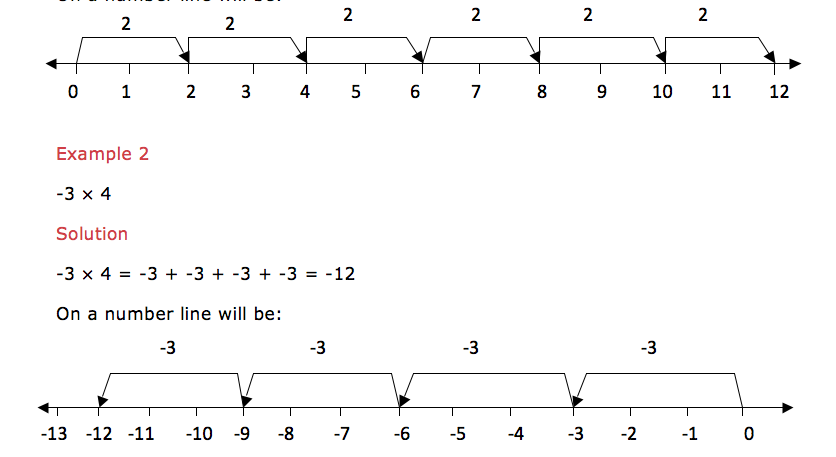
Multiplication of a negative integer by a negative integer cannot be shown on a number line but the product of these two negative integers is a positive integer.
From the above examples we note that multiplication of two positive integers is a positive integer. And multiplication of a positive integer by a negative integer is a negative integer. In summary:
- (+)×,(+) = (+)
- (-)×,(-) = (+)
- (+)×,(-) = (-)
- (-)×,(+) = (-)
Division of Integers
Divide integers
Example 26
6÷3 is the same as saying that, which number when you multiply it by 3 you will get 6, that number is 2, so, 6÷3 = 2.
Therefore division is the opposite of multiplication. From our example 2×3 = 6 and 6÷3 = 2. Thus multiplication and division are opposite to each other.
Dividing two integers which are both positive the quotient (answer) is a positive integer. If they are both negative also the quotient is positive. If one of the integer is positive and the other is negative then the quotient is negative. In summary:
- (+)÷(+) = (+)
- (-)÷(-) = (+)
- (+)÷(-) = (-)
- (-)÷(+) = (-)
Mixed Operations on Integers
Perform mixed operations on integers
You may be given more than one operation on the same problem. Do multiplication and division first and then the rest of the signs. If there are brackets, we first open the brackets and then we do division followed by multiplication, addition and lastly subtraction. In short we call it BODMAS. The same as the one we did on operations on whole numbers.
Example 27
=3 + 6 -1 (first divide and multiply)
=8 (add and then subtract)
Example 28
=1 + 4 – 7 (do operations inside the brackets and divide first)
=2
TOPIC 2: FRACTIONS
A fraction is a number which is expressed in the form of a/b where a - is the top number called numerator and b- is the bottom number called denominator.
A Fraction
Describe a fraction
A fraction is a number which is expressed in the form of a/b where a - is the top number called numerator and b- is the bottom number called denominator.
Consider the diagram below
The shaded part in the diagram above is 1 out of 8, hence mathematically it is written as 1/8

Example 1
(a) 3 out of 5 ( three-fifths) = 3/5
Example 2
(b) 7 0ut of 8 ( i.e seven-eighths) = 7/8
Example 3
- 5/12=(5 X 3)/(12 x 3) =15/36
- 3/8 =(3 x 2)/(8 X 2) = 6/16
Dividing the numerator and denominator by the same number (This method is used to simplify the fraction)
Difference between Proper, Improper Fractions and Mixed Numbers
Distinguish proper, improper fractions and mixed numbers
Proper fraction -is a fraction in which the numerator is less than denominator
Improper fraction -is a fraction whose numerator is greater than the denominator
Mixed fraction -is a fraction which consist of a whole number and a proper fraction
Example 6

(a) To convert mixed fractions into improper fractions, use the formula below
(b)To convert improper fractions into mixed fractions, divide the numerator by the denominator

Example 7
Convert the following mixed numbers into improper fractions

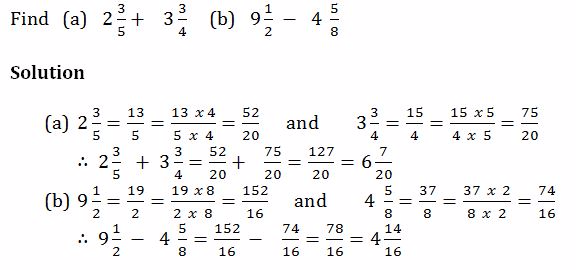
Addition of Fractions
Add fractions
Operations on fractions involves addition, subtraction, multiplication and division
- Addition and subtraction of fractions is done by putting both fractions under the same denominator and then add or subtract
- Multiplication of fractions is done by multiplying the numerator of the first fraction with the numerator of the second fraction, and the denominator of the first fraction with the denominator the second fraction.
- For mixed fractions, convert them first into improper fractions and then multiply
- Division of fractions is done by taking the first fraction and then multiply with the reciprocal of the second fraction
- For mixed fractions, convert them first into improper fractions and then divide
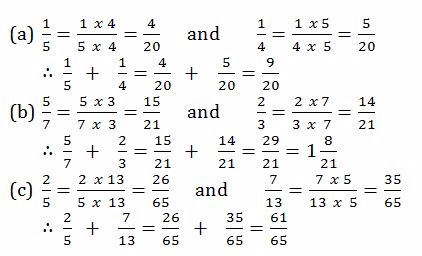
Example 11
Find

Solution
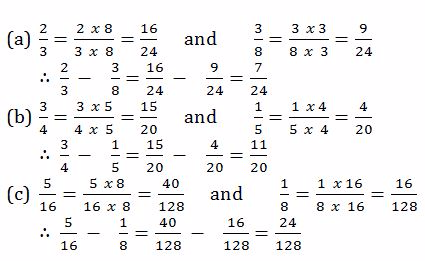
Subtraction of Fractions
Subtract fractions
Example 12
Evaluate

Solution
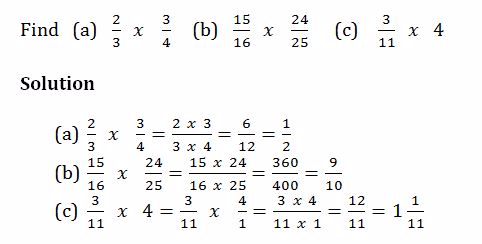
Multiplication of Fractions
Multiply fractions
Example 13
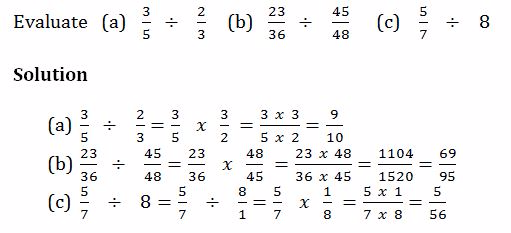
Division of Fractions
Divide fractions
Example 14
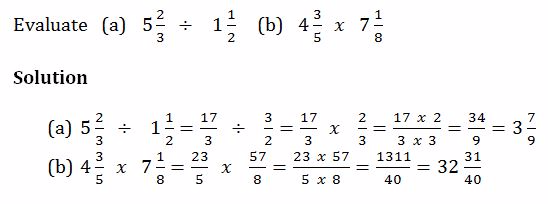
Mixed Operations on Fractions
Perform mixed operations on fractions
Example 15
Example 16
Word Problems Involving Fractions
Solve word problems involving fractions
Example 17
- Musa is years old. His father is 3¾times as old as he is. How old is his father?
- 1¾of a material are needed to make suit. How many suits can be made from
TOPIC 3: DECIMAL AND PERCENTAGE
The Concept of Decimals
Explain the concept of decimals
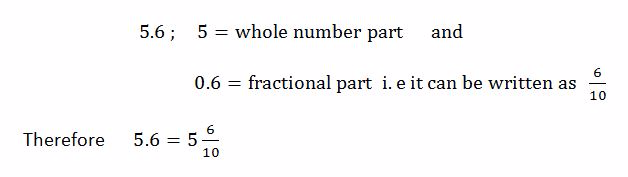
A decimal- is defined as a number which consist of two parts separated by a point.The parts are whole number part and fractional part
Example 1
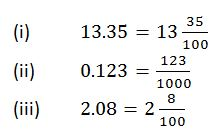
Example 2
Conversion of Fractions to Terminating Decimals and Vice Versa
Convert fractions to terminating decimals and vice versa
The first place after the decimal point is called tenths.The second place after the decimal point is called hundredths e.t.c
Consider the decimal number 8.152

NOTE
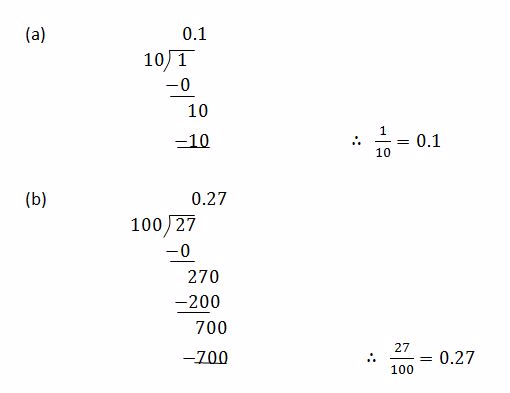
- To convert a fraction into decimal, divide the numerator by denominator
- To convert a decimal into fraction, write the digits after the decimal point as tenths, or hundredths or thousandths depending on the number of decimal places.
Example 3
Convert the following fractions into decimals

Divide the numerator by denominator
Expressing a Quantity as a Percentage
Express a quantity as a percentage
The percentage of a quantity is found by converting the percentage to a fraction or decimal and then multiply it by the quantity.
Example 9
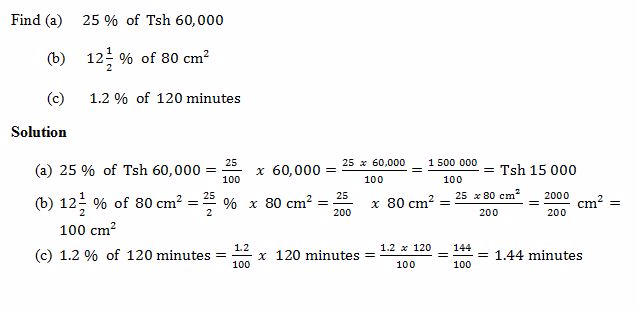
NOTE:The concept of percentage of a quantity can be used to solve the problems involving percentage increase and decrease as shown in the below examples:-
A Fractions into Percentage and Vice Versa
Convert a fraction into percentage and vice versa
To change a fraction or a decimal into a percentage, multiply it by 100%
Example 10
Convert the following fractions into percentages
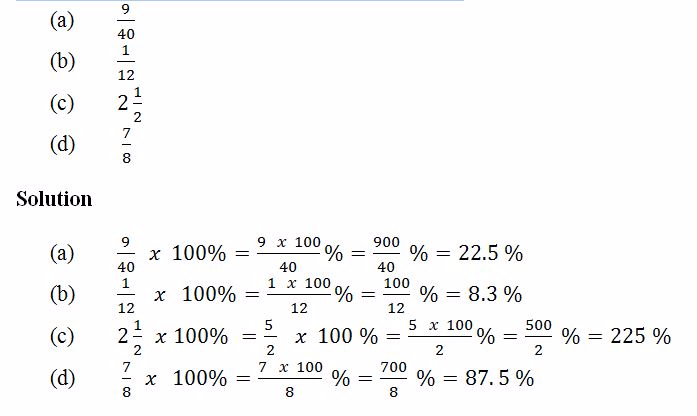
A Decimal into Percentage and Vice Versa
Convert a decimal into percentage and vice versa
To change a percentage into a fraction or a decimal, divide it by 100%
Example 11
Convert the following percentages into decimals
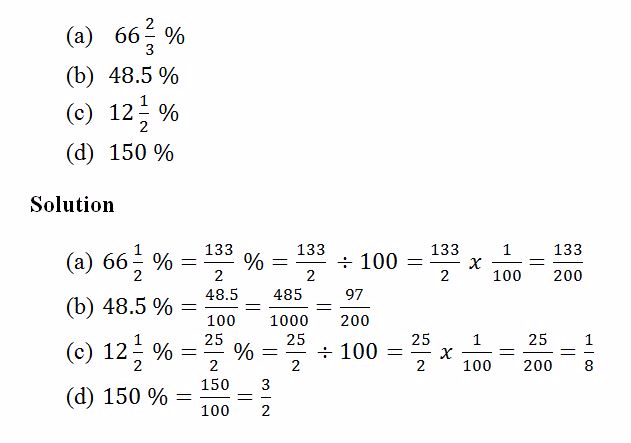
Percentages in Daily Life
Apply percentages in daily life
Example 12
In an assignment, Regina scored 9 marks out of 12. Express this as a percentage
Solution
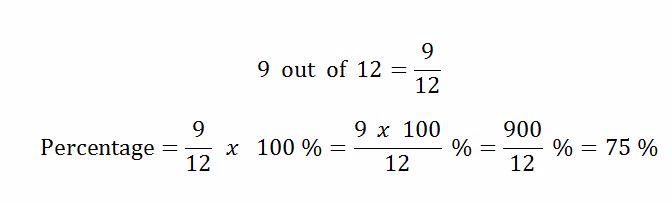
Example 13
A school has 400 students of which 250 are girls. What percentage of the students are not girls?
Solution
 TOPIC 7: ALGEBRA
An algebraic expression – is a collection of numbers, variables, operators and grouping symbols.Variables - are letters used to represent one or more numbers
Symbols to form Algebraic Expressions
Use symbols to form algebraic expressions
The parts of an expression collected together are called terms
Example
- x + 2x – are called like terms because they have the same variables
- 5x +9y – are called unlike terms because they have different variables
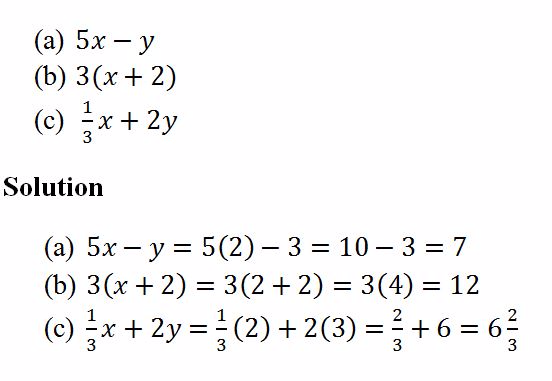
An algebraic expression can be evaluated by replacing or substituting the numbers in the variables
Example 1
Evaluate the expressions below, given that x = 2 and y = 3
Example 2
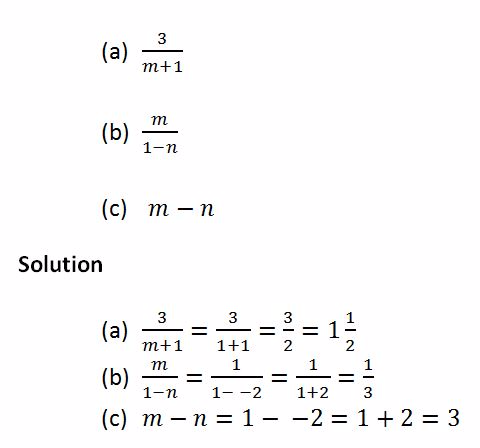
Evaluate the expressions below, given that m = 1 and n = - 2
An expression can also be made from word problems by using letters and numbers
Example 3
A rectangle is 5 cm long and w cm wide. What is its area?
Simplifying Algebraic Expressions
Simplify algebraic expressions
Algebraic expressions can be simplified by addition, subtraction, multiplication and division
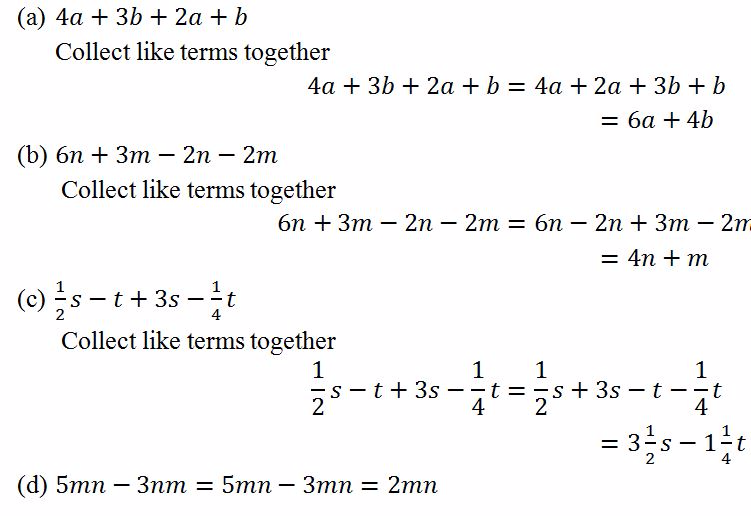
Addition and subtraction of algebraic expression is done by adding or subtracting the coefficients of the like terms or letters
Coefficient of the letter – is the number multiplying the letter
<!--[endif]-->Multiplication and division of algebraic expression is done on the coefficients of both like and unlike terms or letters
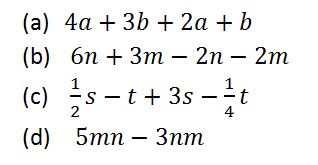
Example 4
Simplify the expressions below
Solution
An inequality – is a mathematical statement containing two expressions which are not equal. One expression may be less or greater than the other.The expressions are connected by the inequality symbols<,>,≤ or≥.Where< = less than,> = greater than,≤ = less or equal and ≥ = greater or equal.
Linear Inequalities with One Unknown
Solve linear inequalities in one unknown
An inequality can be solved by collecting like terms on one side.Addition and subtraction of the terms in the inequality does not change the direction of the inequality.Multiplication and division of the sides of the inequality by a positive number does not change the direction of the inequality.But multiplication and division of the sides of the inequality by a negative number changes the direction of the inequality
Example 11
Solve the following inequalities

Linear Inequalities from Practical Situations
Form linear inequalities from practical situations
To represent an inequality on a number line, the following are important to be considered:
- The endpoint which is not included is marked with an empty circle
- The endpoint which is included is marked with a solid circle
Example 12
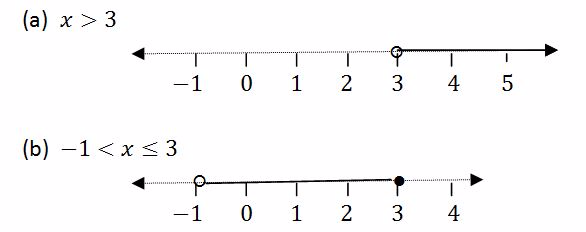
Compound statement – is a statement made up of two or more inequalities
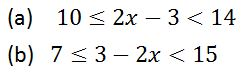
Example 13
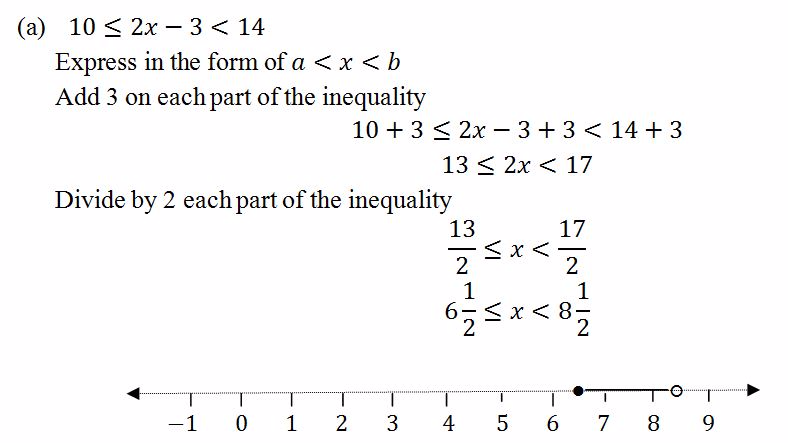
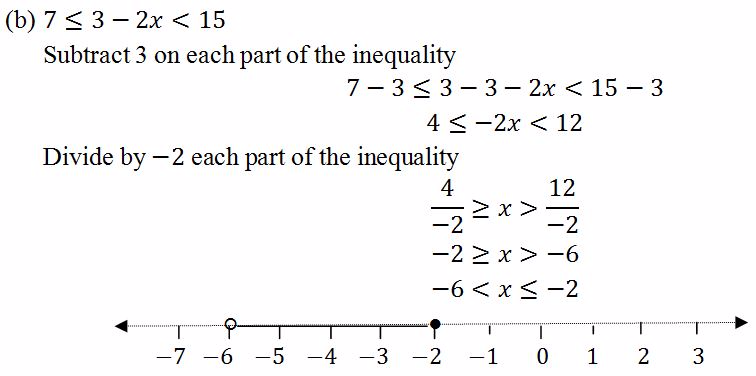
Solve the following compound inequalities and represent the answer on the number line
Solution
TOPIC 8: NUMBERS
A Rational Number
Define a rational number
ARational Numberis a real number that can be written as a simple fraction (i.e. as aratio). Most numbers we use in everyday life are Rational Numbers.
| Number | As a Fraction | Rational? |
|---|---|---|
| 5 | 5/1 | Yes |
| 1.75 | 7/4 | Yes |
| .001 | 1/1000 | Yes |
| -0.1 | -1/10 | Yes |
| 0.111... | 1/9 | Yes |
| √2(square root of 2) | ? | NO ! |
The square root of 2 cannot be written as a simple fraction! And there are many more such numbers, and because they arenot rationalthey are calledIrrational.
The Basic Operations on Rational Numbers
Perform the basic operations on rational numbers
Real Numbers
Real Numbers
Define real numbers
he type of number we normally use, such as 1, 15.82, −0.1, 3/4, etc.Positive or negative, large or small, whole numbers or decimal numbers are all Real Numbers.
They are called "Real Numbers" because they are not Imaginary Numbers.
Absolute Value of Real Numbers
Find absolute value of real numbers
The absolute value of a number is the magnitude of the number without regard to its sign. For example, the absolute value of 𝑥 𝑜𝑟 𝑥 written as 𝑥 . The sign before 𝑥 is ignored. This is because the distance represented is the same whether positive or negative. For example, a student walking 5 steps forward or 5 steps backwards will be considered to have moved the same distance from where she originally was, regardless of the direction.
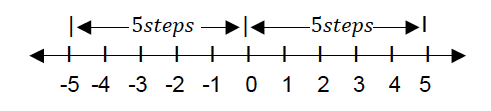
The 5 steps forward (+5) and 5 steps backward (-5) have an absolute value of 5
Thus |𝑥| = 𝑥 when 𝑥 is positive (𝑥 ≥ 0), but |𝑥| = −𝑥 when 𝑥 is negative (𝑥 ≤ 0).
For example, |3| = 3 since 3 is positive (3 ≥ 0) And −3 = (−3) =3 since −3 is negative (3 ≤ 0)
Related Practical Problems
Solve related practical problems
Example 5
Solve for 𝑥 𝑖𝑓 |𝑥| = 5
For any number 𝑥, |𝑥| = 5, there are two possible values. Either 𝑥,= +5 𝑜𝑟 𝑥 = 5
Example 6
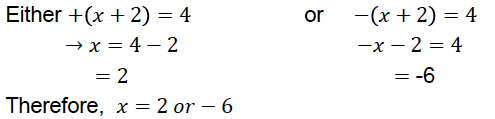
Solve for 𝑥, given that |𝑥 + 2| =4
Solution
TOPIC 9: RATIO, PROFIT AND LOSS.
Ratio
A ratio – is a way of comparing quantities measured in the same units
Examples of ratios
- A class has 45 girls and 40 boys. The ratio of number of boys to the number of girls = 40: 45
- A football ground 100 𝑚 long and 50 𝑚 wide. The ratio of length to the width = 100: 50
NOTE: Ratios can be simplified like fractions
- 40: 45 = 8: 9
- 100: 50 = 2: 1
A Ratio in its Simplest Form
Express a ratio in its simplest form
Example 1
Simplify the following ratios, giving answers as whole numbers
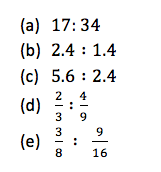
Solution
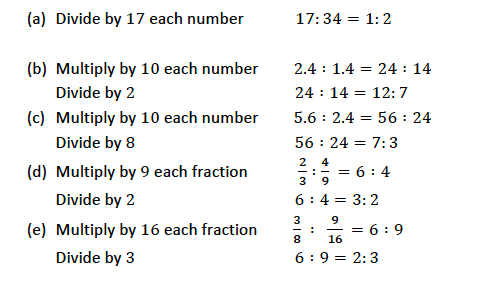
A Given Quantity into Proportional Parts
Divide a given quantity into proportional parts
Example 2
Express the following ratios in the form of
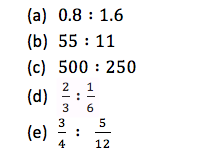
Solution
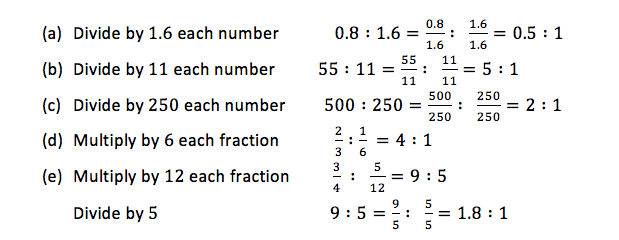
To increase or decrease a certain quantity in a given ratio, multiply the quantity with that ratio
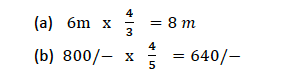
Example 3
- Increase 6 𝑚 in the ratio 4 ∶ 3
- Decrease 800 /− in the ratio 4 ∶ 5
Solution
Simple Interest
Calculate simple interest
The amount of money charged when a person borrows money e. g from a bank is called interest (I)
The amount of money borrowed is called principle (P)
To calculate interest, we use interest rate (R) given as a percentage and is usually taken per year or per annum (p.a)

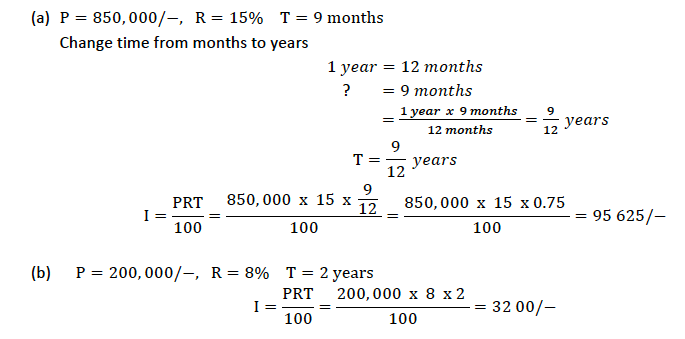
Example 6
Calculate the simple interest charged on the following
- 850, 000/− at 15% per annum for 9 months
- 200, 000/− at 8% per annum for 2 years
Solution
Real Life Problems Related to Simple Interest
Solve real life problems related to simple interest
Example 7
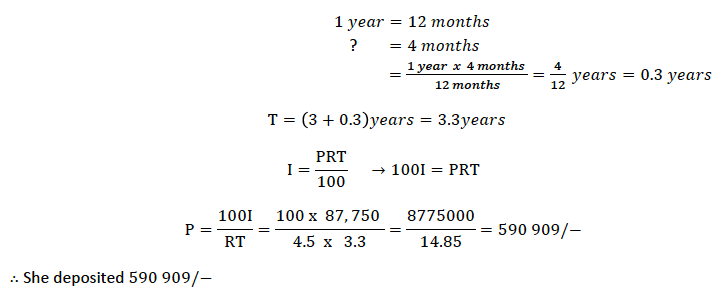
Mrs. Mihambo deposited money in CRDB bank for 3 years and 4 months. A t the end of this time she earned a simple interest of 87, 750/− at 4.5% per annum. How much had she deposited in the bank?
Given I = 87, 750/− R = 4.5% % T = 3 years and 4 months
Change months to years
TOPIC 10: COORDINATE OF A POINT
Read the coordinates of a point
Coordinates of a points – are the values of 𝑥 and 𝑦 enclosed by the bracket which are used to describe the position of a point in the plane
The plane used is called 𝑥𝑦 − plane and it has two axis; horizontal axis known as 𝑥 − axis and; vertical axis known as 𝑦 − axis
A Point Given its Coordinates
Plot a point given its coordinates
Suppose you were told to locate (5, 2) on the plane. Where would you look? To understand the meaning of (5, 2), you have to know the following rule: Thex-coordinate (alwayscomes first. The first number (the first coordinate) isalwayson the horizontal axis.
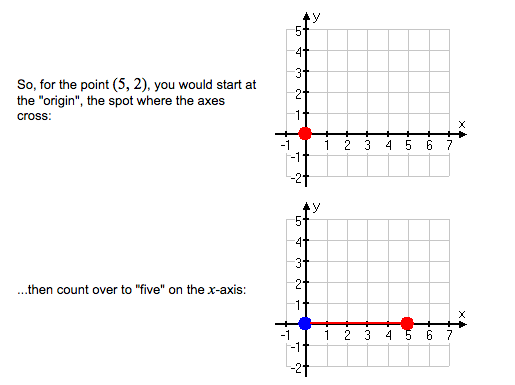
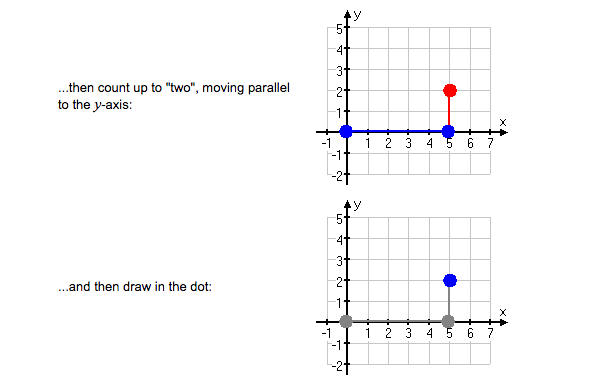
A Point on the Coordinates
Locate a point on the coordinates
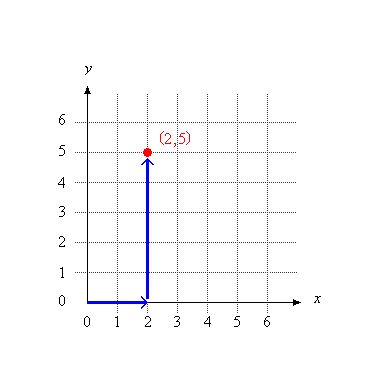
The location of (2,5) is shown on the coordinate grid below. Thex-coordinate is 2. They-coordinate is 5. To locate (2,5), move 2 units to the right on thex-axis and 5 units up on they-axis.
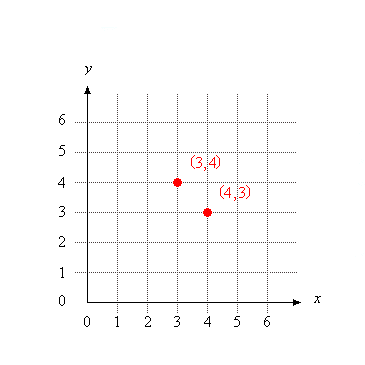
The order in which you writex- andy-coordinates in an ordered pair is very important. Th ex-coordinate always comes first, followed by they-coordinate. As you can see in the coordinate grid below, the ordered pairs (3,4) and (4,3) refer to two different points!
Simultaneous Equations
Linear Simultaneous Equations Graphically
Solve linear simultaneous equations graphically
Use the intercepts to plot the straight lines of the simultaneous equations. The point where the two lines cross each other is the solution to the simultaneous equations
Example 7
Solve the following simultaneous equations by graphical method
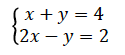
If 𝑥 = 0, 0 + 𝑦 = 4 𝑦 = 4
If 𝑦 = 0, 𝑥 + 0 = 4 𝑥 = 4
Draw a straight line through the points 0, 4 and 4, 0 on the 𝑥𝑦 − plane
If 𝑥 = 0, 0 − 𝑦 = 2 𝑦 = −2
If 𝑦 = 0, 2𝑥 − 0 = 2 𝑥 = 1
Draw a straight line through the points (0,−2) and (1, 0) on the 𝑥𝑦 − plane
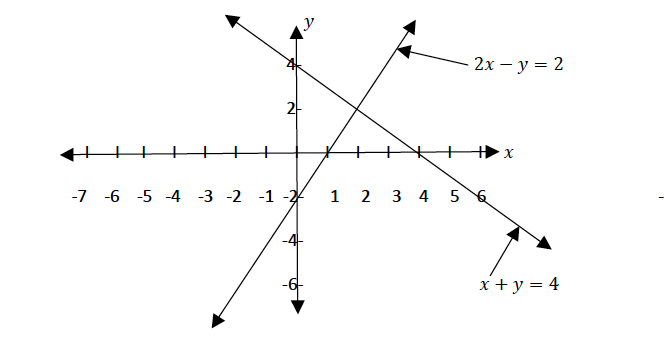
From the graph above the two lines meet at the point 2, 2 , therefore 𝑥 = 2 𝑎𝑛𝑑 𝑦 = 2
TOPIC 11: PERIMETERS AND AREAS
Perimeters of Triangles and Quadrilaterals
The Perimeters of Triangles and Quadrilaterals
Find the perimeters of triangles and quadrilaterals
Perimeter – is defined as the total length of a closed shape. It is obtained by adding the lengths of the sides inclosing the shape. Perimeter can be measured in 𝑚𝑚 , 𝑐𝑚 ,𝑑𝑚 ,𝑚,𝑘𝑚 e. t. c
Examples
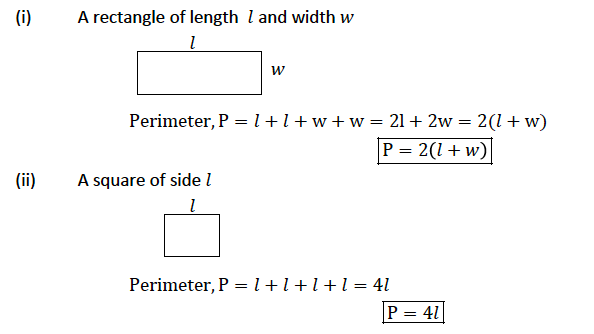
Example 1
Find the perimeters of the following shapes
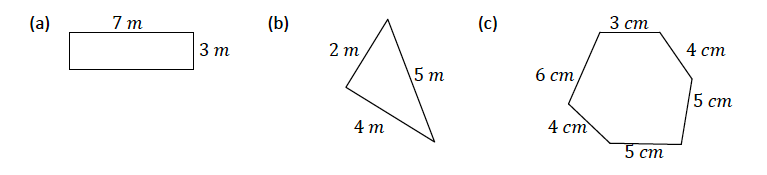
Solution
- Perimeter = 7𝑚 + 7𝑚 + 3𝑚 + 3𝑚 = 20 𝑚
- Perimeter = 2𝑚 + 4𝑚 + 5𝑚 = 11 𝑚
- Perimeter = 3𝑐𝑚 + 6𝑐𝑚 + 4𝑐𝑚 + 5𝑐𝑚 + 5 𝑐𝑚 + 4𝑐𝑚 = 27 𝑐𝑚
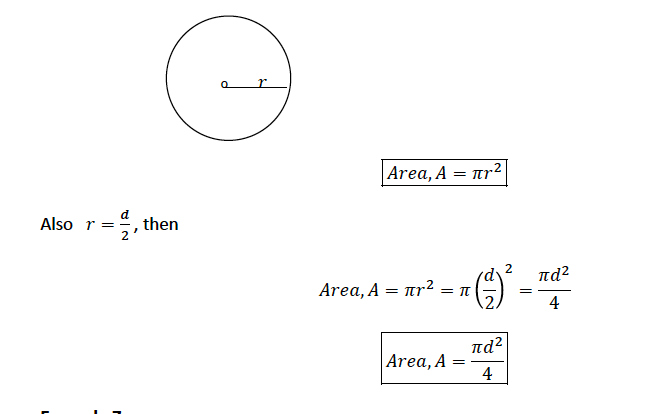
Areas of Circle
Calculate areas of circle
Consider a circle of radius r;
Example 5
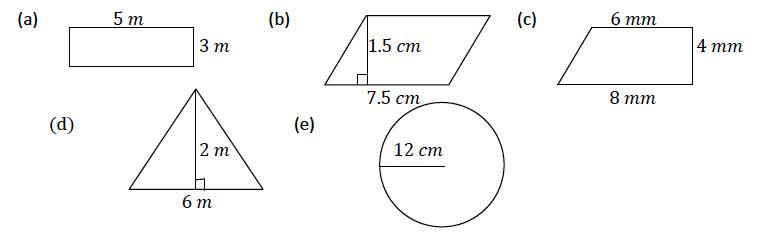
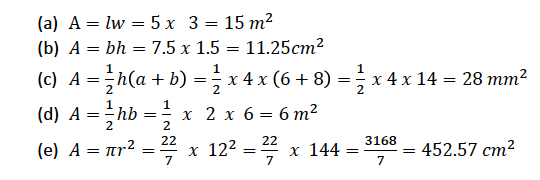
Find the areas of the following figures
Solution
Example 6
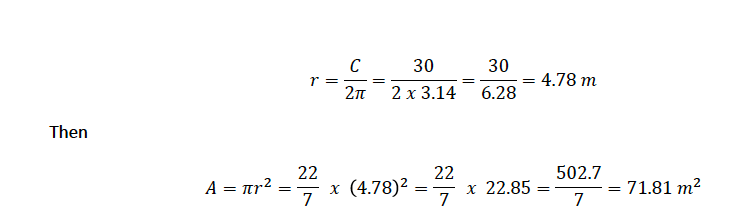
A circle has a circumference of 30 𝑚. What is its area?
Given circumference, 𝐶 = 30 𝑚
C = 2𝜋𝑟
Ndugu mwalimu/mwanafunzi kama unapata changamoto yoyote ile
kuhusu upatikanaji wa NOTES HIZI kwenye website hii, tafadhari wasiliana nasi kwa
simu no/hotline. 0759-104804 Paschal kabonge
barua pepe. paschalkabonge2@gmail.com
au andika maoni yako kwenye sehemu ya comment hapa chini ya post hii.
Kumbuka: mitihani yote inapatikana bureeee kabisa.
Asante.
ELIMU NI HAKI KWA WOTE .
Form One Mathematics Notes Pdf
Source: http://tlr6.blogspot.com/2019/01/mathematics-form-one-full-notes.html
Posted by: howardtheirch.blogspot.com
0 Response to "Form One Mathematics Notes Pdf"
Post a Comment